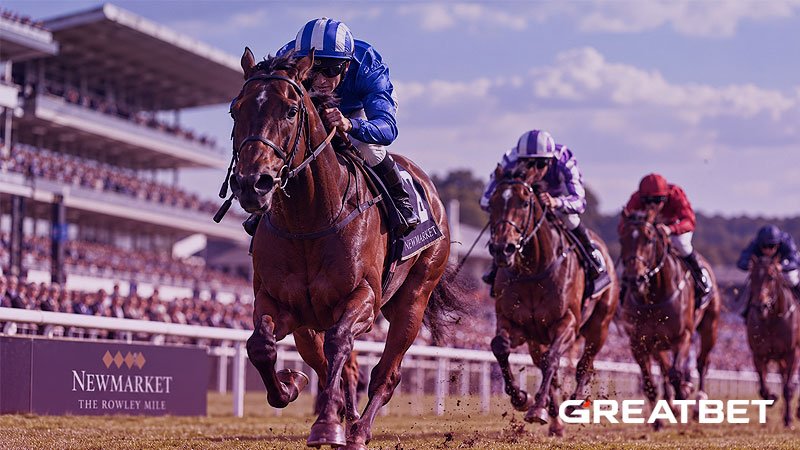
The Cesarewitch Handicap is one of the great stamina tests of the British flat racing calendar. Run over two miles and two furlongs on Newmarket's Rowley Mile, it has been part of the autumn racing scene since 1839 and remains one of the most historic handicaps in the sport.
Origins of the Cesarewitch Handicap
The race was first run in 1839, with the inaugural winner a horse named Cruiskeen. Its unusual name is an anglicised form of Tsesarevich, the title given to the heir to the Russian throne, and honours Tsesarevich Alexander, who later became Tsar Alexander II.
From the beginning the Cesarewitch was a test of stamina as much as speed. At two miles and two furlongs, or 3,621 metres, it is a marathon by flat racing standards, open to horses aged three and older and run under handicap conditions, with weights allocated according to each horse's official rating. Today it carries Heritage Handicap status, a mark of its place among the most prestigious handicaps in Britain.
The Autumn Double
The Cesarewitch was founded in the same year as the Cambridgeshire Handicap, another major Newmarket race, and the pair became known as the Autumn Double. The Cesarewitch was originally run first, but the order was later reversed, and it now takes place roughly two weeks after the Cambridgeshire.
Winning both races in the same season has always been a rare feat, and only three horses managed it in the 19th century: Rosebery in 1876, Foxhall in 1881 and Plaisanterie in 1885. The achievement has seldom been attempted since, which only adds to the legend of those who carried it off.
Foxhall and a Famous Cesarewitch Handicap Double
Of the three Autumn Double winners, Foxhall is the best remembered. Bred in the United States and owned by James R. Keene, he was the outstanding colt in Europe as a three-year-old in 1881, a season in which he also won the Grand Prix de Paris.
His autumn campaign was remarkable. Trained by William Day, Foxhall won the Cesarewitch on 11 October 1881 and then returned to Newmarket just three days later for the Cambridgeshire. Having won the first leg, he was given a 14-pound penalty by the handicapper, yet he still triumphed by a head in a field of 32 runners, carrying 126 pounds and beating strong opposition that included Bend Or and Tristan. Day regarded it as the most marvellous performance on record, and it remains one of the most celebrated feats in the history of British handicap racing.
Other Famous Renewals and Records
The Cesarewitch has a history of producing surprises. Aaim To Prosper is the most successful horse in the race's history, winning in 2010 at 16/1 and again in 2012 at 66/1, the only horse to take the race twice. Scatter Dice matched that 66/1 price when winning in 2013, while Caracciola won at 50/1 in 2008, underlining how often the race rewards outsiders.
The record books also reflect the long reach of the contest. Doug Smith is the leading jockey with six victories, riding Canatrice, French Design, Sandiacre, Come to Daddy, Alcove and Persian Lancer to success. Among trainers, William Day and Mathew Dawson share the record with four wins each, Day's tally including Foxhall.
The race has also developed a strong association with trainers from the jumping world, whose horses are bred and campaigned to stay long distances. Willie Mullins trained three consecutive winners from 2018 to 2020, finishing with Great White Shark in 2020, while Nicky Henderson, Alan King and Philip Hobbs have also found success in the race. Henderson's Buzz won in 2021 under Oisin Murphy.
The Rowley Mile and Newmarket
The Cesarewitch is run on the Rowley Mile course at Newmarket in Suffolk, widely regarded as the historic home of British horseracing. The Rowley Mile is the venue for many of the sport's biggest autumn and spring fixtures, and hosts the race as part of a wider programme of high-class racing.
The race's place in the calendar has shifted over the years. It was formerly staged during Newmarket's Champions' Day meeting in mid-October, became part of a new fixture called Future Champions Day in 2011, and was separated from that card in 2014. Since 2015 it has returned to the Saturday of the Future Champions Festival, where it remains a centrepiece of the meeting.
Why the Cesarewitch Handicap Endures
Few races combine heritage, difficulty and unpredictability quite like the Cesarewitch. The extreme distance rewards stamina and tactical judgement, the handicap system keeps contests tightly balanced, and the field sizes allow for the kind of big-priced winners that give the race its character.
That blend has kept the Cesarewitch Handicap relevant for well over a century and a half, from the days of Cruiskeen and Foxhall through to the modern era of jumps-trained stayers. It remains a fixture on the autumn calendar and one of the traditional highlights of the Newmarket season.