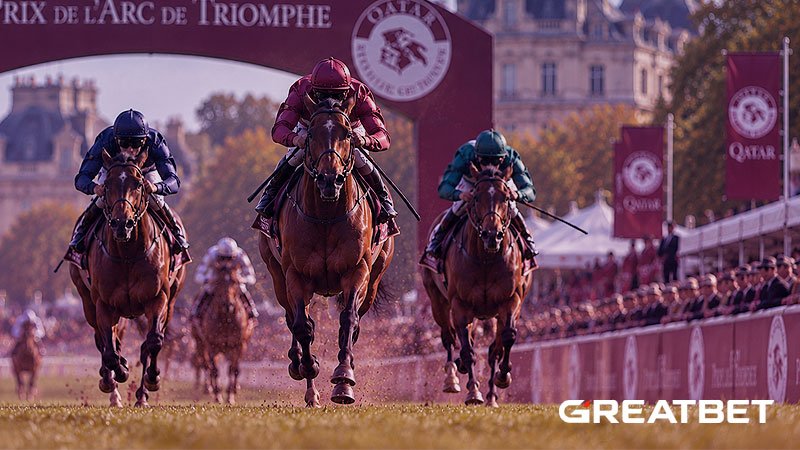
The Prix de l'Arc de Triomphe is widely regarded as the most prestigious middle-distance race in European flat racing. Run over 2,400 metres at ParisLongchamp, it brings together the best Derby winners, older champions and top fillies from across Europe, and its roll of honour reads like a history of the thoroughbred.
Origins of the Prix de l'Arc de Triomphe
The race was first run on 3 October 1920, created in the aftermath of the First World War to showcase French thoroughbred breeding and to compare the merits of Europe's finest horses. It took its name from the Arc de Triomphe in Paris, the monument beneath which Allied forces marched in the victory parade of 1919. An alternative suggestion at the time was to call it the Prix de la Victoire.
The Arc replaced an earlier race, the Prix du Conseil Municipal, which dated back to 1893. It was deliberately scheduled for early October so that three-year-olds had time to develop before facing their elders. The race was suspended only in 1939 and 1940, and was run at Tremblay rather than Longchamp in 1943 and 1944.
ParisLongchamp and the Venue
The Arc is run at Longchamp Racecourse, on the western edge of Paris, now known as ParisLongchamp following its redevelopment. During that renovation the race was staged at Chantilly in 2016 and 2017, before returning to its traditional home. The course lies within the Bois de Boulogne and is run right-handed on turf, with a long home straight where stamina and tactical judgement are often decisive.
The distance is 2,400 metres, or one and a half miles, and the race is open to horses aged three and older. Three-year-olds carry 56.5 kg and older horses 59.5 kg, with a 1.5 kg allowance for fillies and mares. The fastest time recorded in the race is 2 minutes 23.61 seconds, set by Found at Chantilly in 2016, while the Longchamp record of 2 minutes 24.49 seconds belongs to Danedream, who won in 2011.
Great Renewals of the Prix de l'Arc de Triomphe
Many of the finest horses of the 20th and 21st centuries have won the Arc. Ribot, unbeaten in his career, won back-to-back runnings in 1955 and 1956, taking the second by six lengths and defeating the Irish Derby winner Talgo.
Sea-Bird in 1965 is often regarded as the greatest Arc performance of all. Ridden by Pat Glennon and trained by Etienne Pollet, he beat Reliance by six lengths in a field that included the French Derby winner, the Prix de Diane winner, the Irish Derby winner Meadow Court and the American champion Tom Rolfe. Mill Reef followed in 1971, trained by Ian Balding, winning by three lengths in a course record time after already landing the Derby, the Eclipse and the King George.
Dancing Brave, ridden by Pat Eddery, won a thrilling renewal in 1986 by one and a half lengths. The field included the German Horse of the Year Acatenango and the French Derby winner Bering. More recently, Sea The Stars secured the Arc in 2009 for jockey Mick Kinane and trainer John Oxx, completing a remarkable unbeaten season that also included the 2,000 Guineas, the Derby, the Eclipse, the Juddmonte International and the Irish Champion Stakes.
Multiple Winners and Records
Winning the Arc once is a career-defining achievement, so doing it twice is exceptional. Eight horses have won the race two times: Ksar (1921 and 1922), Motrico (1930 and 1932), Corrida (1936 and 1937), Tantieme (1950 and 1951), Ribot (1955 and 1956), Alleged (1977 and 1978), Treve (2013 and 2014) and Enable (2017 and 2018). None has managed a third.
Frankie Dettori is the leading jockey with six wins, while Andre Fabre is the leading trainer with eight. Marcel Boussac and Khalid Abdullah share the record for owners with six victories each. The race has also seen three disqualifications, in 1925, 1959 and 1985.
Fillies, Mares and International Winners
The Arc has been kind to the female of the species. Urban Sea won in 1993 and later became the dam of Sea The Stars, who won the race himself in 2009. Zarkava, unbeaten in her career, took the 2008 renewal, and Alpinista won in 2022. In total, more than 20 fillies and mares have won the race, helped by the weight allowance they receive.
France has the most winners, which is fitting given the race's origins, but the Arc has long been a truly international contest. British and Irish-trained horses have won it regularly, and Italy and Germany have also produced winners. Qatar has sponsored the race since 2008, helping to establish it as one of the richest turf races in Europe. Success in the Arc is widely seen as the crowning achievement of a horse's career and carries enormous prestige for its owner, trainer, jockey and breeder alike.